Identify your grass, diagnose problems, and get a lawn care plan that works
Point your camera at your lawn. Lawn Care AI identifies your grass type, spots weeds and diseases in seconds, and builds a year-round care schedule tuned to your lawn and your local weather.
Free to download · AI lawn scan included
Three steps to a healthier lawn
No guesswork, no generic advice. Everything starts with what's actually growing in your yard.
Scan your lawn
Take a photo. The AI grass identifier names your grass type and detects weeds, diseases, and problem areas in seconds.
Get your plan
Receive a personalized year-round lawn care schedule — mowing, feeding, seeding, aeration — built for your grass and your region.
Act at the right moment
Weather-aware reminders tell you when to water, when rain has you covered, and when conditions are right for each task.
See it in action
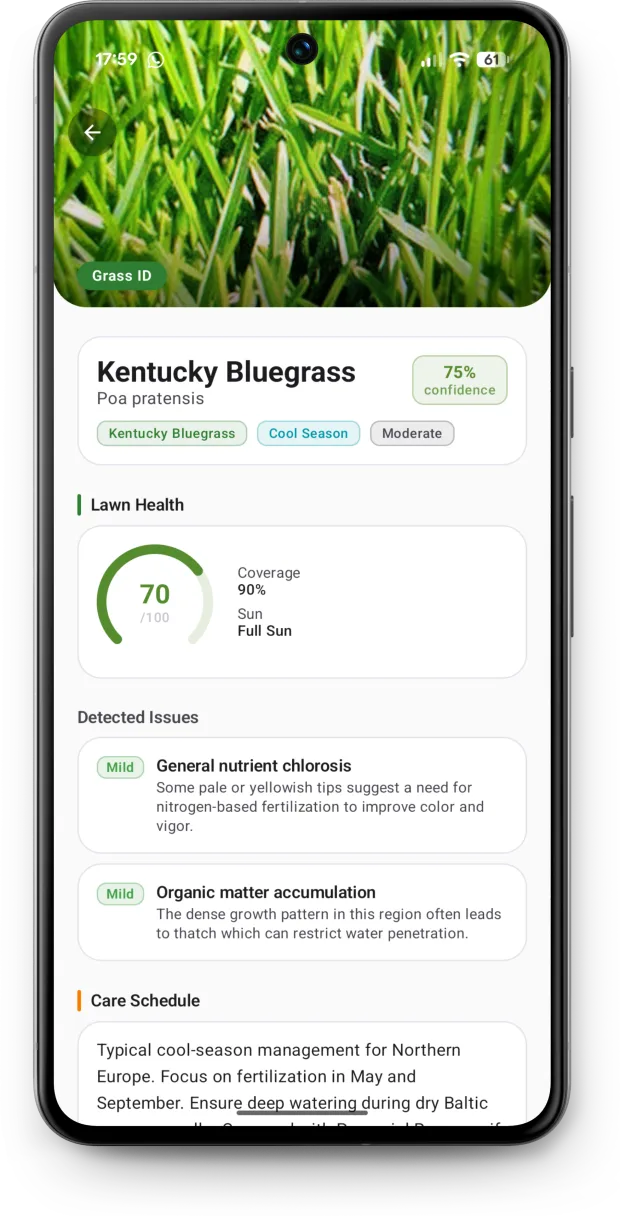
Real screens from the app — scan results, your personalized schedule, and instant AI advice.
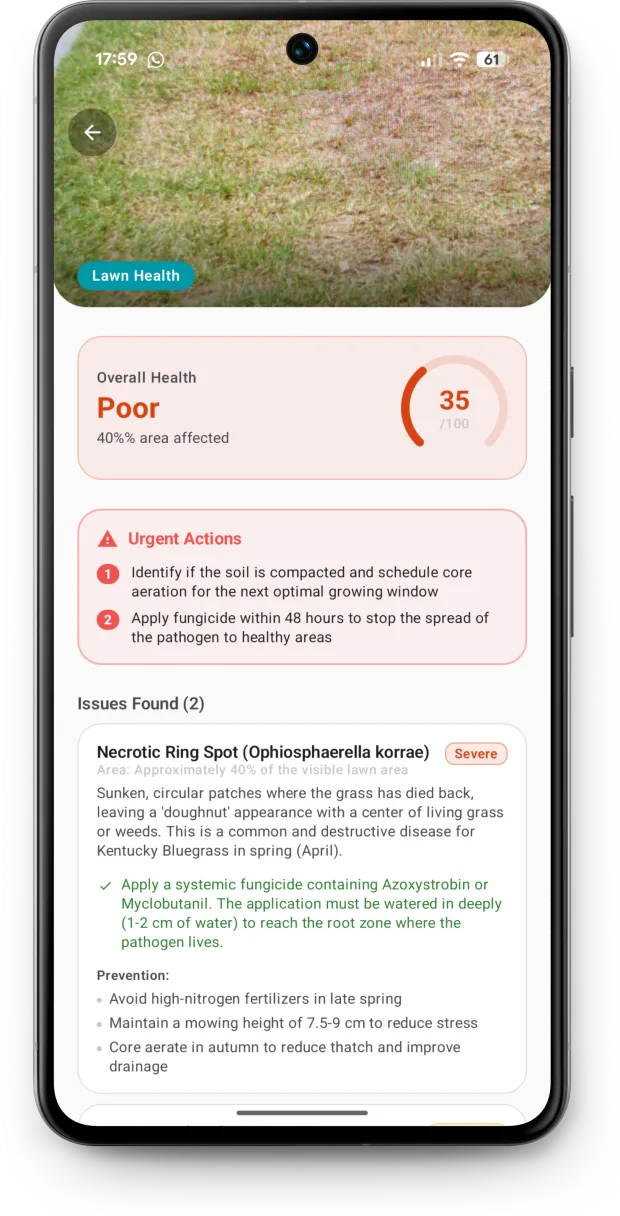
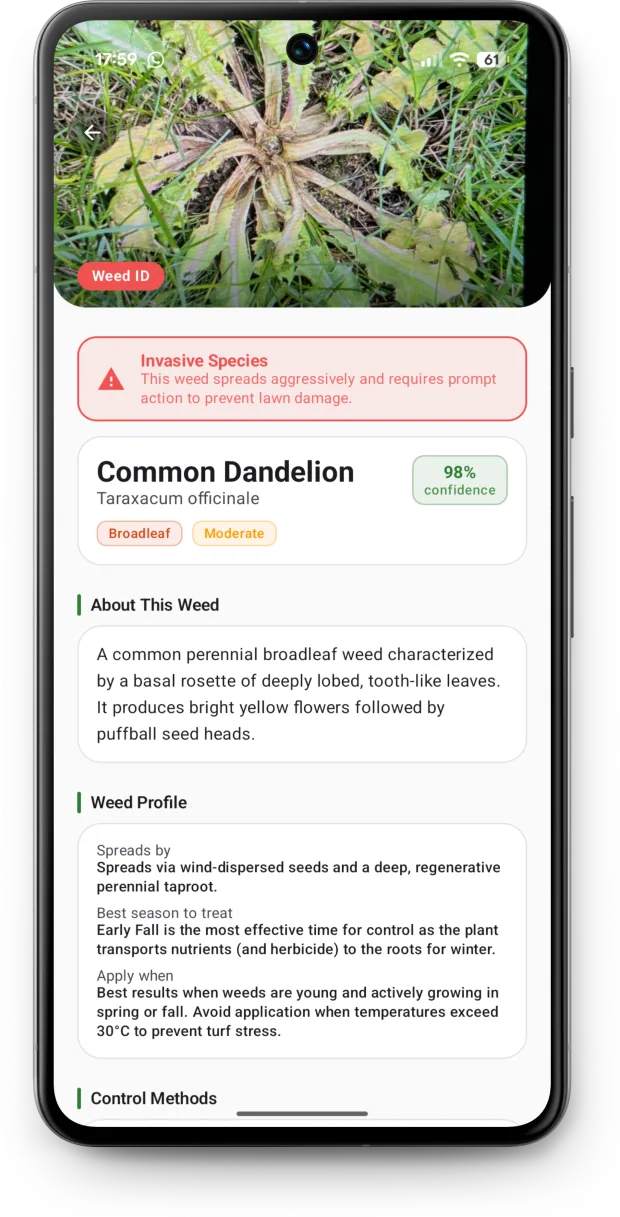
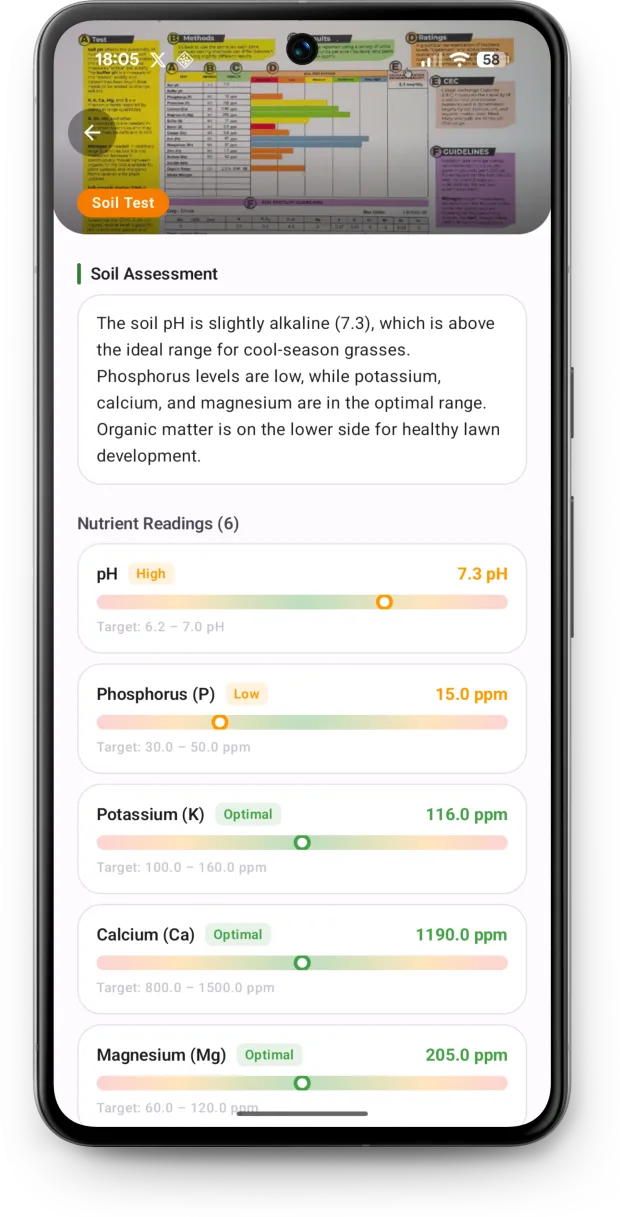
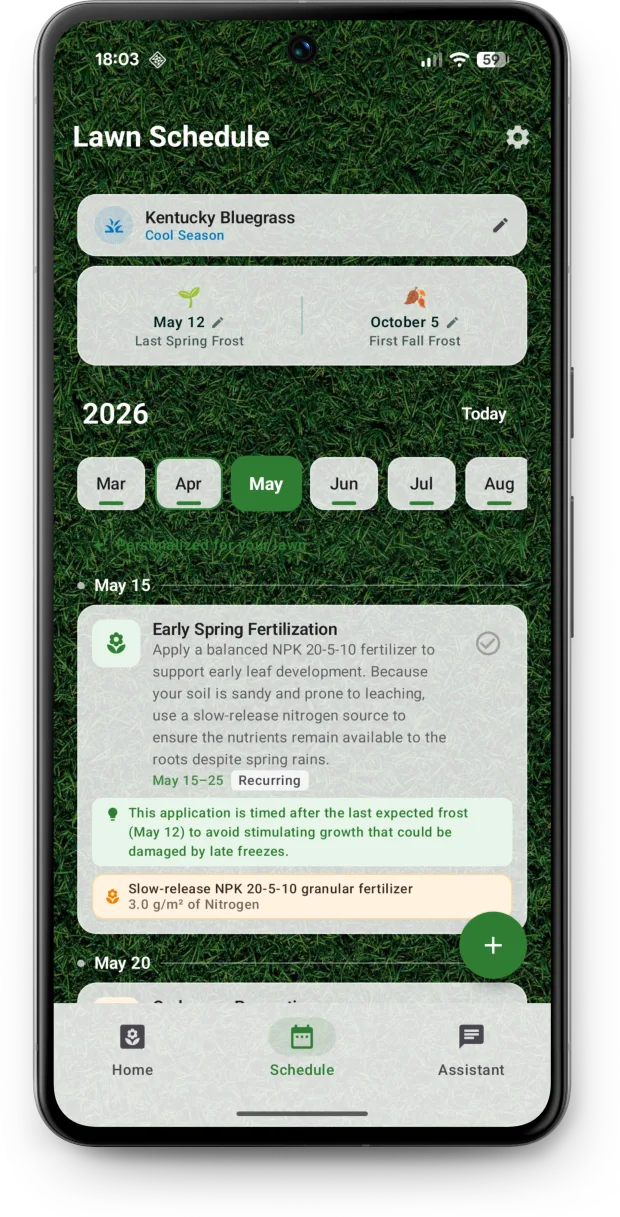
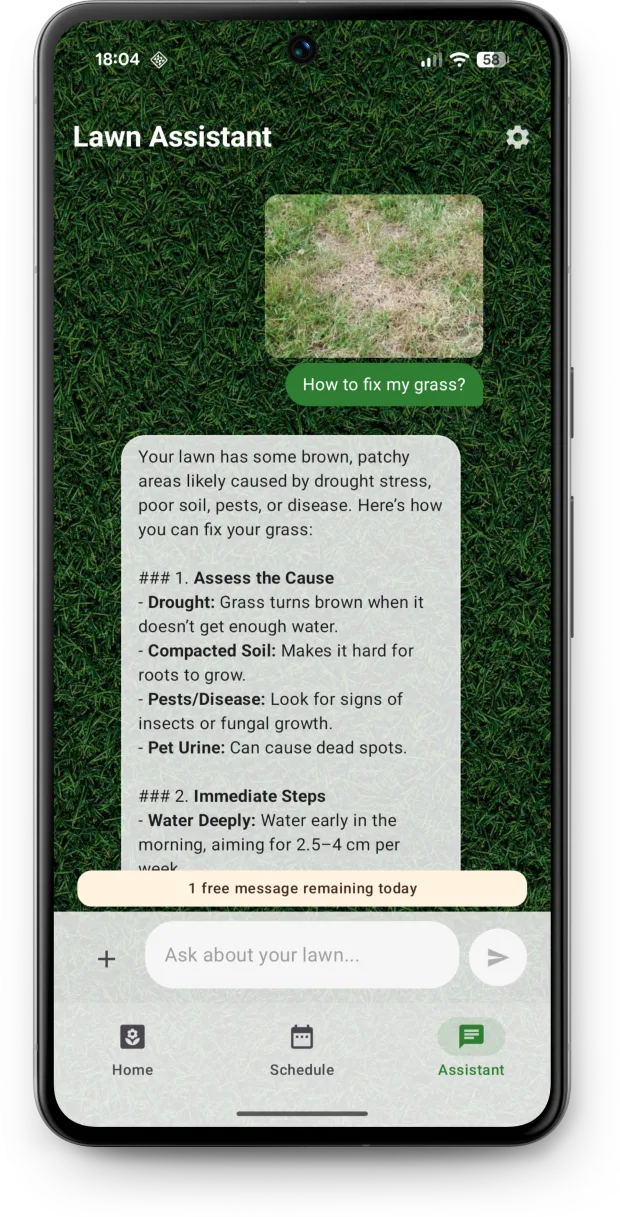
Grass ID, weed & disease diagnosis, and a smart schedule — in one app
Built around live local weather — not a printed calendar.
AI grass, weed & disease identifier
Snap a photo to identify your grass type and diagnose weeds, fungus, and lawn diseases — with treatment guidance for each.
Personalized year-round schedule
A lawn care plan tuned to your grass type, region, and season — from spring green-up to winter dormancy.
Weather-smart watering
Tracks rainfall and evapotranspiration for your exact location. It tells you when to water — and when nature already did it for you.
Soil-test tuned care
Scan your soil test results and the app adjusts fertilizer type and timing to what your soil is actually missing.
Watering log & home widget
Log light, medium, or deep waterings right from your home screen and watch the app net them against your lawn's water deficit.
Reminders that respect the forecast
Rain coming? Tasks that shouldn't happen on wet grass go on hold automatically — you'll be nudged when the moment is right.
What kind of grass do I have?
Mowing height, watering depth, and feeding windows all depend on your grass type. Here are the most common lawn grasses and how to recognize them.
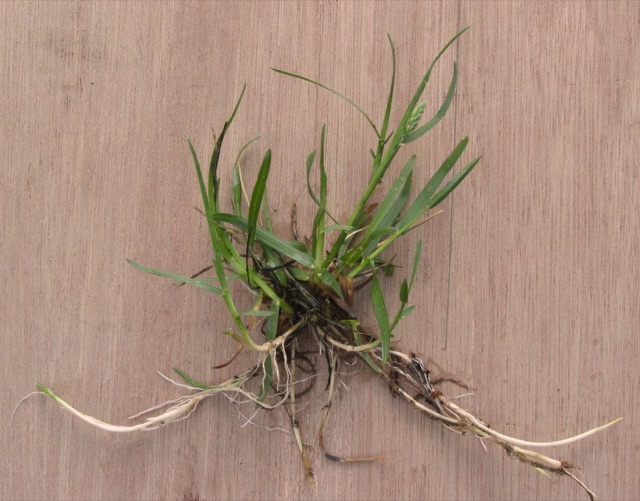
Kentucky Bluegrass Cool-season
The classic dense, dark-green northern lawn. Boat-shaped leaf tips; spreads by rhizomes and self-repairs. Mow 2.5–3.5", feed heaviest in fall.
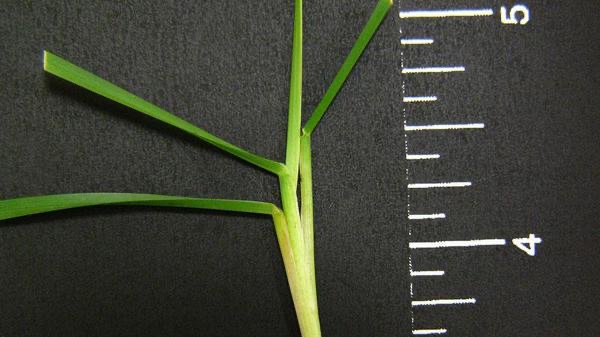
Perennial Ryegrass Cool-season
Fast germinating with fine, glossy blades and reddish stem bases. Great for overseeding and high-traffic areas. Mow 2–3".
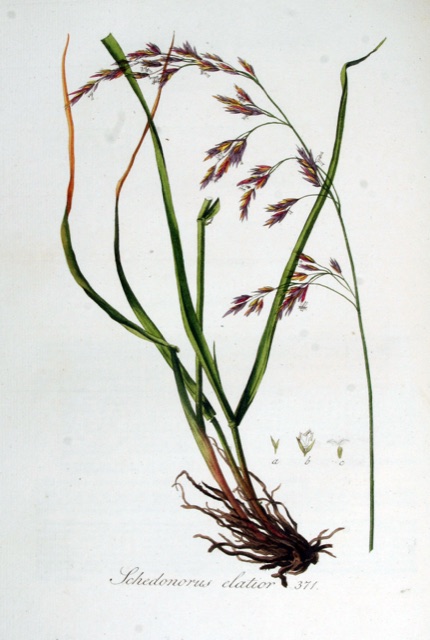
Tall Fescue Cool-season
Wide, ribbed blades in coarse bunches. Deep roots make it the most drought-tolerant cool-season grass. Mow high at 3–4".
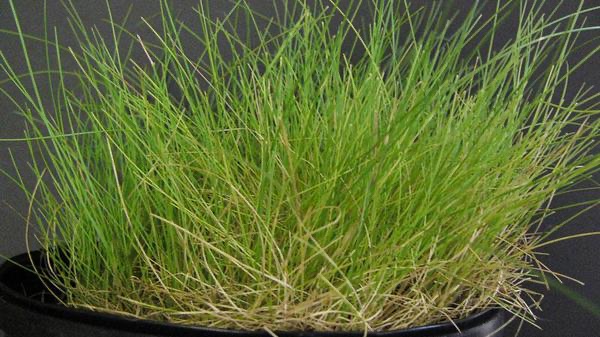
Fine Fescue Cool-season
Needle-fine blades that thrive in shade and poor soil with little fertilizer. Ideal for low-maintenance lawns.
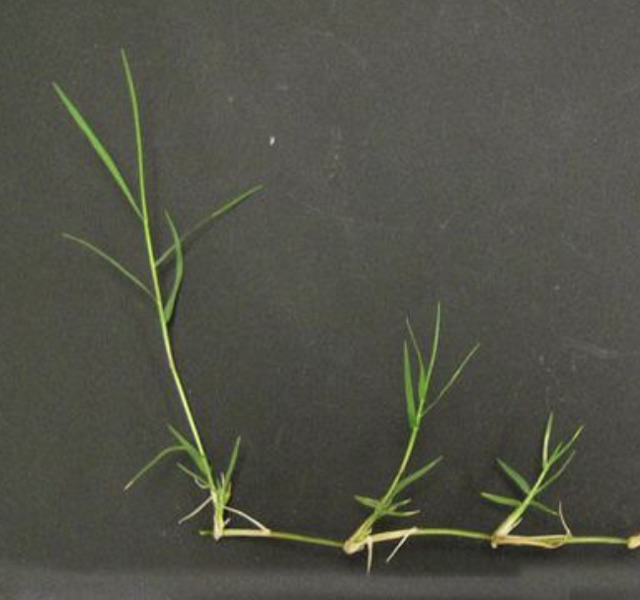
Bermuda Grass Warm-season
Aggressive, sun-loving southern favorite spreading by wiry runners. Loves heat. Mow low at 1–2", feed in summer.
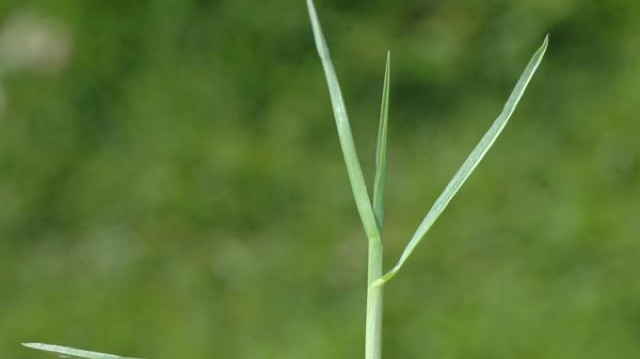
Rough Bluegrass Cool-season
Thrives in damp, shaded spots where other grasses struggle — but browns out in hot, dry sun.
Want the full identification walkthrough? Read our grass identification guide — or scan your lawn with the app and let the AI name it from a photo.
Lawn care basics that actually matter
Four fundamentals fix most struggling lawns. The app times each one for you.
Never cut more than ⅓ of the blade
Scalping stresses grass and invites weeds. Keep cool-season grasses around 3–4" and mow often enough that each cut removes only a third.
→ See the lawn mowing guide for heights by grass type.Water deeply, not daily
About 1 inch per week — rainfall included — in one or two deep sessions grows deep, drought-proof roots. Daily sprinkles grow shallow, needy ones.
→ Learn exactly how much in the lawn watering guide.Feed in the right window
Cool-season lawns feed heaviest in fall; warm-season lawns in late spring through summer. Fertilizing at the wrong time feeds weeds instead.
→ Find your window in when to fertilize your lawn.Fix the cause, not the symptom
Brown patches can be grubs, fungus, drought, or dog spots — each with a different fix. Guessing wrong wastes a season.
→ Match symptoms in the lawn problem diagnosis guide.Free lawn care guides
Practical, no-fluff answers to the questions every lawn owner asks.
Every lawn care job, step by step
Aeration, dethatching, pre-emergent, fertilizing, liming, grubs, moss and more — clear steps, timing by grass type, and supporting videos.
See the jobs →Free AI lawn care app: what it identifies
The five scans, how the photo analysis works, what AI gets right (and doesn't), and how to judge any lawn app.
Read the guide →What kind of grass do I have?
Identify your grass type by blade shape, color, and growth habit — with photos of the six most common lawn grasses.
Read the guide →What weed is in my lawn?
Identify the 12 most common lawn weeds by leaf, flower, and growth habit — and why the right fix depends on the family.
Read the guide →How often should you water your lawn?
Sprinkler run times for the 1-inch rule, day-by-day schedules for new seed and sod, and the signs of over- and underwatering.
Read the guide →When should you fertilize your lawn?
A month-by-month feeding schedule, nitrogen rates by grass type, how to read the bag — and why fall beats spring up north.
Read the guide →How short should you cut your grass?
Ideal heights by grass type, the ⅓ rule, the first mow for new grass, and how to rescue a scalped or overgrown lawn.
Read the guide →What's wrong with my lawn?
Match your symptom in the diagnosis table, run two 2-minute tests, and jump straight to the right fix — fungus, grubs, weeds, or moss.
Read the guide →Why is my grass turning yellow?
Read the yellowing pattern — watering, nitrogen, iron, disease, or dog — and apply the right fix, not a guess.
Read the guide →How to get rid of crabgrass
Pre-emergent timing, post-emergent options, and the thick-lawn strategy that keeps crabgrass from coming back.
Read the guide →Dog urine spots on grass
Why urine burns lawns (it's nitrogen, not acid), the 4-step spot repair, and prevention that actually works.
Read the guide →Dog urine resistant grass types
Urine tolerance ranked species by species — and how to convert a dog yard to a grass that stops burning.
Read the guide →Brown patches: fungus, grubs, or drought?
Four look-alike causes, two 10-second tests, and the pattern guide that stops you treating the wrong one.
Read the guide →How to fix bare patches
The 6-step reseeding repair, the right timing for your grass type, and why patches return when you skip step one.
Read the guide →Dead or dormant grass?
The tug, crown, and water tests that tell a resting lawn from a dead one — and how to revive each.
Read the guide →Lawn grubs
The square-foot cut test, the 5–10 per sq ft threshold, and which grub treatments work at which time of year.
Read the guide →Get rid of nutsedge
Why the fast-growing weed with the triangular stem shrugs off normal weed killers — and what actually kills it.
Read the guide →Mushrooms in your lawn
Why they appear after rain, whether they harm grass (they don't), and the real caution for kids and pets.
Read the guide →How to overseed
Thicken a thin lawn in fall: the exact timing window, rates by grass type, and week-by-week aftercare.
Read the guide →Soil test results, decoded
What pH, buffer pH, P, K, CEC and organic matter mean on your report — read line by line with a real example.
Read the guide →Frequently asked questions
What is the best app to identify grass type?
Lawn Care AI identifies your grass type from a single photo using AI, then uses the result to tailor mowing heights, fertilizing windows, and watering amounts to your exact lawn. It also identifies weeds and lawn diseases and is free to download on iOS and Android.
How do I find out what type of grass I have?
The fastest way is a photo: scan your lawn with the app and the AI names your grass type in seconds. You can also identify grass manually by blade shape, color, and growth habit — see our grass identification guide for photos of the most common lawn grasses.
Can AI identify lawn diseases and weeds?
Yes. Point your camera at a brown patch, discolored blades, or an unknown weed and the AI diagnoses the likely disease or weed and suggests a treatment. Catching problems early is the difference between a quick fix and a full re-seed.
How often should I water my lawn?
Most lawns need about 1 inch (25 mm) of water per week, including rainfall, delivered in one or two deep sessions rather than daily sprinkles. The app tracks local rainfall and evapotranspiration so it only tells you to water when your lawn actually needs it.
When should I fertilize my lawn?
It depends on your grass type: cool-season lawns feed heaviest in fall and lightly in spring, while warm-season lawns feed in late spring through summer. The app builds these windows into your personalized schedule automatically.
Is Lawn Care AI free?
The app is free to download and includes free lawn scans. A premium plan unlocks the fully personalized year-round schedule, weather-aware reminders, and soil-test-tuned care.
Your best lawn starts with one photo
Download Lawn Care AI, scan your lawn, and get a plan built for your grass, your soil, and this week's weather.